
Decoding Your Trees: Why Pepper Pike’s Green Guardians Need Expert Check-ups
I. Introduction: The Silent Sentinels of Pepper Pike
Your majestic trees aren’t mere ornaments; they’re integral to Pepper Pike’s identity, the silent architects of its coveted charm, and guardians of your property’s well-being. But beneath the verdant canopy, could a hidden danger be lurking? Are those seemingly robust oaks and maples harboring unseen vulnerabilities, posing risks that extend beyond mere aesthetics?
Enter the realm of arborist consultations and tree risk assessments. These aren’t just services reserved for emergencies; they are proactive investments, vital check-ups for the very lifeblood of Pepper Pike. Especially in our uniquely verdant community, a place where the rustling of leaves is as much a part of the soundscape as the hum of traffic, understanding the health and structural integrity of our trees is paramount.
Why Pepper Pike, you ask? Because we are unique. We cherish our “bucolic” environment, a tapestry woven with mature trees that have witnessed generations come and go. But this beauty comes with responsibility. Ohio’s weather, a capricious dance of scorching summers and icy winters, places immense stress on our arboreal companions. Proactive tree care isn’t merely advisable here; it’s an essential act of stewardship.
II. A Walk Through Time: Pepper Pike’s Love Affair with Trees
Pepper Pike’s devotion to its natural landscape isn’t a recent trend; it’s a deeply ingrained part of our history, a legacy etched into the very fabric of our community since its incorporation in 1924. This commitment is celebrated by the city’s continued “Tree City USA” designation.
This dedication is formalized in Chapter 1494 of the city’s codified ordinances, appropriately titled “Tree Regulations.” These aren’t arbitrary rules; they are a carefully considered framework designed to preserve our trees for a multitude of reasons: to manage stormwater runoff, prevent erosion, provide habitats for wildlife, enhance the aesthetic appeal of our surroundings, and safeguard property values. These regulations are not static. They evolve, adapt, and strengthen over time, reflecting a community that truly cherishes its canopy.
The 2021 amendment to Chapter 1494 exemplifies this proactive approach. It signifies a renewed commitment to bolstering tree care regulations, ensuring that Pepper Pike’s urban forest remains resilient and vibrant for years to come.
III. The Art and Science of Tree Whispering: What Expert Arborists Do
An arborist consultation is more than a casual glance; it’s a meticulous examination, a nuanced dialogue between expert and tree. Arborists don’t just guess; they diagnose, analyze, and prescribe with the precision of a seasoned physician.
The Hazardous Tree Assessment, in particular, is a deep dive into the arboreal psyche. What secrets do the trees reveal? The trained eye discerns cracks that whisper of structural weakness, decay that eats away at the heartwood, weak branches poised for collapse, telltale signs of insect infestation, and root issues that undermine the very foundation of the tree’s existence.
And what are the “targets” of these potential hazards? Our homes, our sidewalks, our vehicles, and even our beloved petunias – all vulnerable to the consequences of a failing tree. From assessment to action, the arborist guides us through a spectrum of solutions: pruning to alleviate stress, cabling to provide support, or, as a last resort, removal to prevent disaster.
Pepper Pike is fortunate to have access to a wealth of local tree care expertise. Firms like VanCuren Tree Service, Davey Tree, Roubic Tree Care, and COH Tree Care, among others, bring years of experience to our community. Look for ISA Certified Arborists and those with TRAQ (Tree Risk Assessment Qualification) credentials.
But the world of tree care is not stuck in the past. Arborists are increasingly embracing high-tech tools to enhance their diagnostic capabilities. Resistograph drills allow them to peer inside the tree’s trunk, mapping the density of the wood and detecting hidden decay. Sound tomography creates detailed internal images, much like an MRI for your oak. And for a truly comprehensive view, climbing arborists conduct aerial assessments, meticulously examining every branch and leaf from the vantage point of the canopy itself.
IV. Navigating the Green Tape: Pepper Pike’s Tree Rules
Understanding Pepper Pike’s tree regulations is crucial for responsible property ownership. A key question: When do you need a permit to remove a tree? Generally, any tree with a Diameter at Breast Height (DBH) of 6 inches or greater requires a permit for removal.
However, there are exceptions. Trees that are dead, diseased, or damaged often qualify for exemptions, as do emergency situations and work performed by utility companies.
For homeowners undertaking new construction, specific rules apply. The “4-tree rule” or “8-inch DBH rule” dictates specific preservation or replacement requirements, ensuring that new development doesn’t come at the expense of our existing tree canopy.
And speaking of replacement, be prepared to plant 1.5 new trees for every one you remove. This commitment to reforestation underscores Pepper Pike’s dedication to maintaining its green character.
Protecting trees during construction is equally important. Tree protection plans are essential for mitigating damage to root systems, preventing soil compaction, and ensuring the long-term health of trees near construction sites.
While Pepper Pike hasn’t been embroiled in any widely publicized “tree removal controversies,” the city’s carefully crafted regulatory framework speaks volumes about the community’s dedication to balanced tree management. Even seemingly minor issues, like the 2023 sidewalk debate, highlight residents’ unwavering commitment to preserving the city’s “semi-rural” feel and its precious tree canopy.
V. Beyond the Chainsaw: The Future of Tree Care
The future of tree care extends far beyond the roar of the chainsaw. Technology is taking root in exciting new ways.
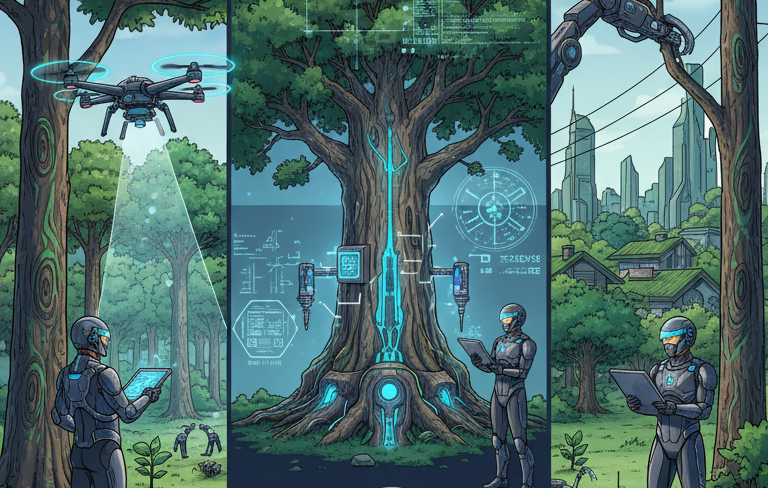
Drones are becoming increasingly prevalent for aerial assessments, offering a safer, more efficient way to inspect trees from above. Artificial intelligence is emerging as the tree doctor’s assistant, predicting diseases, optimizing watering schedules, and monitoring environmental conditions with unparalleled precision. Robotics and automation are streamlining hazardous tasks, with remote-controlled grapple saws enabling safer tree removal, especially near power lines.
The focus is shifting from mere removal to proactive preservation, with arborists increasingly viewed as “tree doctors” dedicated to extending the lifespan and enhancing the health of our arboreal companions. Greener practices are gaining traction, with organic fertilizers, natural pest control methods, and the growing adoption of electric equipment for quieter, cleaner operations.
As our climate changes, the demand for diverse, climate-resilient tree species is growing, paving the way for stronger, more adaptable urban forests.
Yet, amidst all these technological advancements, the human touch remains indispensable. The skilled hands and experienced eyes of certified arborists will always be essential for intricate tasks and expert judgment, ensuring that our trees receive the personalized care they deserve.
VI. Conclusion: Your Role in Pepper Pike’s Pristine Landscape
Let us remember, expert arborist consultations are not an extravagance, but a necessity. They are vital for ensuring the safety, health, and longevity of our trees, and for maintaining compliance with Pepper Pike’s local regulations.
I urge you, seek out ISA Certified Arborists for comprehensive assessments and familiarize yourselves with Pepper Pike’s tree care rules.
By embracing proactive tree care, we, the residents of Pepper Pike, can safeguard our beloved trees, preserving the city’s unique charm and ensuring that future generations will continue to revel in the beauty of our verdant landscape.